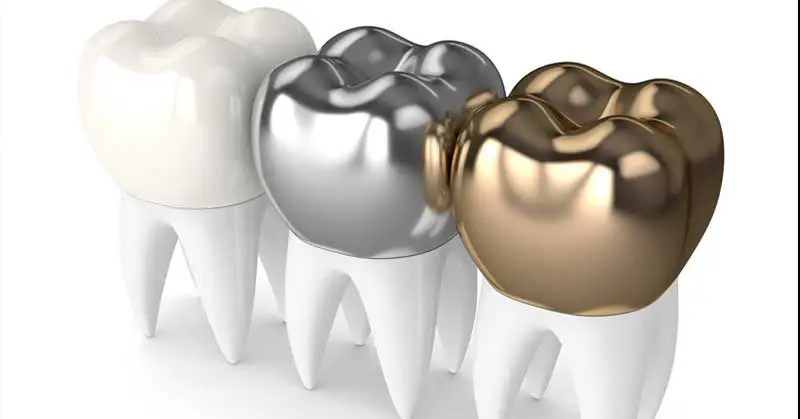
Over time, your teeth can get damaged. This can happen for a
variety of reasons, like tooth decay, injuries or just use over time. Your
teeth can lose their shape or size. Dental crowns are tooth-shaped “caps” that
can be placed over your tooth. Think of it like a snug hat for your tooth. The
crown restores the tooth’s shape, size, strength and appearance.
The dental crown is cemented into place on your tooth and it
covers the visible portion of the tooth.
You may need a dental crown for several reasons, including:
Protecting a weak tooth (possibly from decay) from breaking
or to keep the weak tooth together if parts of it are cracked.
Restoring a broken tooth or a severely worn down tooth.
Covering and supporting a tooth with a large filling and not
much tooth remaining.
Holding a dental bridge in place.
Covering misshapen or severely discolored teeth.
Covering a dental implant.
Covering a tooth that’s been treated with a root canal.
A PFM crown has much of the aesthetic appeal of all-ceramic,
but with heightened durability. The interior of the crown – the part which
encompasses the original tooth – contains a small metal thimble, which is then
covered by a visually pleasing porcelain exterior.
With the base being made of metal, you can generally enjoy
more structural integrity and a decreased risk of fracture. Meanwhile, the
porcelain cover keeps the tooth looking natural and attractive.
That said, PFM crowns may not always look as convincing as
all-ceramic. Some people may find they can see the metal thimble through the
porcelain, or around the edges of the tooth. If your gums recede, it's possible
the metal will create dark lines around your tooth.
Porcelain fused-to-metal (PFM) crowns are another widely
used type of dental crowns. They provide both strength (due to their metal
structure) and aesthetics (due to the porcelain coat that covers the cap).
Types-of-Dental-Crowns-porcelain-fused-to-metalThe main ADVANTAGES
of PFM crowns are:
They provide
durability
They’ve been around for over 50 years. We know they work
well.
They are less costly than all porcelain crowns
However, the DISADVANTAGES of PFMs include:
The metal in these crowns may cause a grey line at the
gumline. This may not give the 100% aesthetic look that all porcelain crowns
provide.
For people who clench their teeth, this type of crown may
wear down more easily against the opposing teeth.
You will typically have two visits to the dentist to prepare
for a dental crown. In some cases, you may have a dental crown made in your
dentist’s office.
The first visit
During the first visit, the tooth that’s going to receive
the crown is examined and prepared. X-rays are taken of the tooth and the bone
around it. Your dentist might have to do a root canal treatment before your
dental crown procedure if there’s any:
Tooth decay.
Risk of infection.
Injury to the tooth’s pulp.
Pulp is the soft tissue inside your teeth that contains
blood vessels, nerves and connective tissue.
The tooth that’s receiving the crown will be filed down
across the top and sides. This will make space for the crown itself. The amount
of tooth that gets filed away depends on the type of crown you have. All-metal
dental crowns are thinner and don’t need as much of the tooth removed as
all-porcelain or porcelain-fused-to-metal crowns. If too much of your tooth is
missing — due to damage or decay — a filling material can be used to “build up”
enough tooth structure for the crown to cover.
After reshaping the tooth, a paste or putty is used to make
a copy (also called a impression) of the tooth that’s going to receive the
crown. Impressions of the teeth above and below the tooth that’s getting the
dental crown will also be made. This is done to make sure that the crown will
not affect your bite.
The impressions are sent to a dental laboratory. The
laboratory makes the crowns and usually returns them to the dentist’s office in
two to three weeks. During this first office visit, your dentist will make a
temporary crown to cover and protect the prepared tooth while you’re waiting on
the permanent crown.
Thanks to their experience, dentist at Side Dental Clinic
will help you have metal-ceramic crowns.
The second visit
At the second visit, the permanent crown is placed on your
tooth. First, the temporary crown is removed and the fit and color of the
permanent crown is checked. If everything is okay, a local anesthetic
(“numbing” drug) is sometimes used to numb the tooth and the new crown is
permanently cemented in place.
Same-day dental crowns
Dental crowns can also be made in a dentist’s office if your
dentist has the equipment. This process starts off similarly to the traditional
way a crown is made — the first steps are to remove decay and shape the tooth
for a perfect fit inside the crown. After these steps, the actual making of the
crown is different. In the same-day procedure, a scanning device (a “wand”) is
used to take digital pictures of the tooth inside your mouth. The computer’s
software creates a 3D model of the tooth from these pictures. The digital
design is then sent to another in-office machine that carves the shape of the
crown out of a block of ceramic. This method of making a dental crown is called
computer-aided design/computer-aided manufacturing (CAD/CAM). In less than 15
minutes, the crown is ready to be cemented into place.


"Such a pleasant company to deal with, great communication and service... Can totally recommend"
 Official Partner
 Certified Clinic
Internationally Accredited Health Tourism Provider